
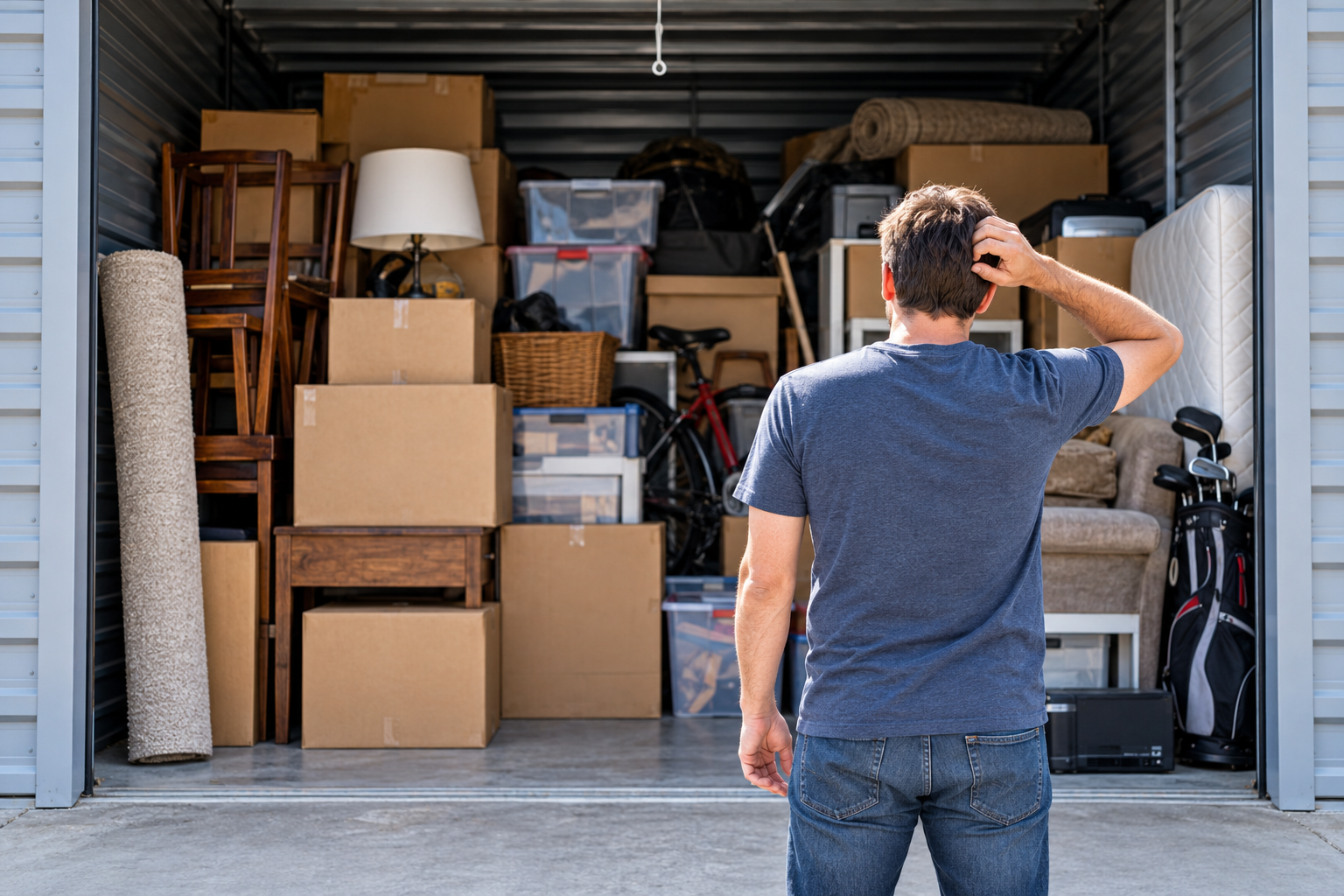
There's a particular kind of box that ends up in a storage unit. You haven't opened it since the last move, but you don't want to throw it away either. Maybe it holds old kitchen supplies, clothes that no longer fit, or something you were certain you'd use again. Put enough of those boxes together with an extra couch and a few pieces of furniture, and renting a storage unit can seem like the simplest solution.
For a while, it often is. The question is what happens a year or two later, when the unit is still full and another monthly payment is due. How much have you paid to keep everything, and is it still worth the expense? The answer isn't necessarily the same for every renter. Some belongings are costly to replace; others are taking up paid space simply because no one has decided what to do with them.
The Cost of Storage Adds Up Faster Than Many Renters Realize
Self-storage is usually billed monthly, which makes a long-term commitment feel fairly manageable. A $120 payment may not stand out alongside rent, insurance, and other bills. Over two years, though, that's $2,880 in storage fees. At $175 a month, the same two-year period costs $4,200. Neither example includes moving expenses, insurance, or possible increases in rent.
Those amounts aren't far-fetched. Figures from the 2022 Self-Storage Almanac, reported by The Washington Post in February 2022, put the 2021 national average monthly cost of a 10-by-10-foot unit at $111.67 without climate control and $146.72 with it. Using those averages, a full year of storage would have cost approximately $1,340 or $1,761, respectively. Actual prices varied by market, facility, and unit type.
Now consider an older bedroom set, a television, some small appliances, and several boxes of household items. They might have cost thousands of dollars when purchased, but that doesn't mean someone would pay thousands to buy them used. It's entirely possible for the accumulated rent to overtake their resale value. That is a financial comparison worth making—not a claim that every storage renter is wasting money.
What Are You Really Paying to Protect?
The amount someone originally spent on an item is not the best way to decide whether to keep storing it. A dining table purchased for $1,500 might be worth only a fraction of that on the secondhand market. A set of tools that looks unremarkable in a box, on the other hand, could be expensive to replace when you need it again.
It helps to separate three questions: What could I sell this for now? What would it cost to replace it? And how likely am I to use it in the foreseeable future? If a family is keeping furniture for a new home they expect to move into next spring, paying for six months of storage might be cheaper than selling the furniture and buying replacements. If the same furniture has sat untouched for three years, the calculation becomes harder to defend.
Some items don't belong in a purely financial calculation. Photographs, family records, inherited furniture, and keepsakes can have value that no resale listing will capture. It may be perfectly reasonable to pay to preserve them. What matters is making that choice deliberately, rather than paying to store dozens of other things alongside them without considering whether those things are needed.
Why We Hang On to Things We Don't Expect to Use Soon
Most people have a few possessions they keep for a possible future use. The coat that might fit again. The exercise equipment that could come in handy. The dishes saved for a special occasion. Often there's a genuine reason to keep them, but there's also a difference between having a plan for an item and feeling reluctant to let it go.
A 2021 study in the Journal of the Association for Consumer Research explored a surprisingly familiar habit: saving items for an occasion that never seems to arrive. Across six studies, researchers Jacqueline Rifkin and Jonah Berger found that choosing not to use something could make it feel more special, particularly when it was being saved for later. That increased sense of specialness could make the item less likely to be used at all.
The research was not a study of self-storage customers. Still, it offers a useful explanation for why a perfectly ordinary possession can remain in a box for years. The longer it goes unused, the more we can start treating it as something that needs to be saved. Meanwhile, the cost of keeping it somewhere else continues every month.
There's another consideration: the items you store may no longer fit your life. Children's toys, extra chairs from an old apartment, or supplies for a discontinued hobby may still be in good condition. But being usable isn't the same thing as being useful to you.
We're Buying New Things While Struggling to Find Room for the Old Ones
Clearing out a storage unit doesn't help much if the emptied space fills up again. Clothes, furniture, decorations, gadgets, and bargain purchases can arrive faster than older possessions are sold, donated, or thrown away. A home gets crowded, things move into the garage, and eventually someone decides that renting a unit would make the house easier to live in.
Consumer spending research gives some perspective. In a May 2022 survey commissioned by Slickdeals, 2,000 U.S. shoppers reported average impulse spending of $314 a month, up from $276 in the previous year's survey. It was a survey of shoppers generally, not people renting storage units, so it cannot tell us how much storage customers buy. It does illustrate how easily unplanned purchases can become another regular expense.
Think about buying a new set of patio chairs while an older set is sitting in storage, or picking up more holiday decorations when several unopened bins are already packed away. These purchases can make sense individually. Over time, however, it's worth asking whether buying more possessions while paying to keep the old ones is working against your household budget.
One practical test is to check what you already own before buying something for a second time. A quick inventory of the storage unit, even a collection of photos on your phone, can prevent duplicate purchases and remind you what is actually in there.
When the Garage Becomes a Second Storage Unit
Paid storage isn't the only place where household belongings pile up. Garages become overflow rooms. Closets fill with items nobody wears. A spare bedroom slowly turns into a place for boxes rather than guests. Sometimes the problem is simply that a household needs more space, particularly after a move or when children arrive. Sometimes the available space isn't being used especially well.
A CRAFTSMAN survey released in November 2022 found that 36% of respondents said their garage was so cluttered they couldn't park a vehicle inside. In the same survey, 52% of respondents with garages said they were dissatisfied with their garage's organization.
Another 2022 survey commissioned by Opendoor asked 5,000 Americans about space at home. Nearly half, 49%, reported having less available room since the pandemic began, while 32% said they had turned a bedroom into a storage room. Neither survey measures how many storage renters could give up their units. They do show that feeling short on room is hardly unusual.
Those numbers also suggest a useful place to start before signing another year of storage payments: look carefully at the space you already have. Maybe the garage needs shelving. Maybe old boxes can be sorted and recycled. Or perhaps the things taking up the most room should be sold instead of moved from one expensive space to another.
Could Better Organization Eliminate the Need for a Storage Unit?
For some people, yes. A thorough sort-through can reveal duplicate items, empty boxes, broken equipment, and furniture no one plans to use. Vertical shelves in a garage, clearly labeled bins, and a more thoughtful closet layout can free up a surprising amount of room. Removing a few bulky things from a storage unit might even make it possible to rent a smaller one.
But organization is not a universal answer. A family living in a small apartment may have no safe place for a full bedroom set. Someone between homes may need off-site storage no matter how well organized the closets are. Climate-sensitive belongings, seasonal business equipment, or possessions awaiting an estate settlement may also require space that simply isn't available at home.
The useful question isn't whether everyone could get rid of their storage unit. It's whether the space you're paying for is solving a problem you still have. If the problem was a temporary move that ended last year, it may be time to reconsider the rental. If the problem is ongoing and legitimate, keeping the unit might be the sensible decision.
How to Tell When Your Storage Unit Is No Longer Worth the Money
Look at the next 12 months, not what you've already paid
Past rental payments are gone, whether you keep the unit or move out. Focus instead on what it will cost to continue. Multiply the current monthly rent by the number of months you expect to need it, add insurance and other fees, and account for possible rent increases. If you don't have an end date in mind, that's a reason to examine the arrangement more closely.
Sort the contents into what you need and what you're postponing
Go through the unit and identify items you expect to use within a specific period. Be realistic about the old furniture, duplicate kitchen appliances, clothing, and equipment. If you plan to sell something, set a date to list it. If it has sentimental value, consider whether a smaller, properly protected space would be enough to keep it.
Compare the cost of storing with the cost of replacing
Suppose you have $900 worth of used furniture in a unit costing $125 a month. Over one year, you'll spend $1,500 in rent. That doesn't automatically mean selling the furniture is the right move: replacing the pieces later might cost more than $900. But the calculation gives you a basis for making the decision instead of letting another year pass.
Don't overlook the less expensive middle ground
You might be able to sell several bulky items and downsize to a smaller unit, move carefully selected belongings home, or finish a planned project sooner. If you do need storage, compare the full cost of available units rather than relying only on a promotional rate. The goal isn't to get rid of storage at any price; it's to stop paying for more space than you need.
A Storage Unit Should Have a Purpose, Not Just a Monthly Payment
There's nothing inherently wasteful about using self-storage. It can make a difficult move easier, protect furniture between homes, and give a business room to operate. For families dealing with major life changes, it can also provide time to make decisions they aren't ready to make immediately.
The risk comes when that temporary convenience turns into a permanent expense nobody questions. If your unit contains things you won't use, things you can easily replace, or things you forgot you had, the cost of keeping them deserves another look. You may decide to keep the unit. You may also discover that a weekend of sorting could save you hundreds or thousands of dollars over the coming years.
The right measure isn't simply how much your belongings are worth. It's what they're worth to you, what they would cost to replace, and how much you're willing to spend to keep them.
Sources
- https://www.washingtonpost.com/home/2022/02/15/self-storage-units-consumer-advice/
- https://doi.org/10.1086/714363
- https://www.prnewswire.com/news-releases/americans-have-increased-their-impulse-spending-by-14-in-2022-compared-to-2021-according-to-annual-survey-commissioned-by-slickdeals-301551014.html
- https://www.prnewswire.com/news-releases/take-back-your-garage-american-garages-store-more-clutter-than-cars-according-to-craftsman-survey-301664129.html
- https://www.opendoor.com/articles/honey-i-shrunk-the-house